
Unlocking the Power of Family Trusts in Kenya: The cheat code to Safeguarding Your Legacy
Updated November 2026 for the Trust Administration Act, 2026 and the Finance Act, 2026. This article first appeared as an X Article in February 2026.
In today’s Kenya, many men (and women) hesitate to walk down the aisle. It isn't that they don’t believe in love. They believe very strongly in property. The fear is simple: one bad breakup and years of sweat, hustle and sleepless nights could be divided by the stroke of a pen. Across town in the courts, estates of the dead routinely sit in court for 20 years or more. The Estate of Mbiyu Koinange has been there for 44 years and counting. Meanwhile, once-close families turn into sworn enemies who would rather die than share a bench at a funeral. Layered onto all this is the unspoken reality that many Kenyan men avoid writing wills, which some see as un-African and a bad omen: an invitation to death itself.
Other times it's the Solomonic lament keeping high-net-worth individuals awake at night: “I hated all the things I had toiled for under the sun, because I must leave them to the one who comes after me. And who knows whether that person will be wise or foolish? Yet they will have control over all the fruit of my toil” (Ecclesiastes 2:18–21). They wonder whether their children will preserve the family legacy or turn it into a fleet of Range Rovers and bad investment decisions. Add escalating taxes, and wealth preservation starts to feel less like planning and more like survival.
Enter family trusts, the quiet overachievers of Kenyan estate planning. A properly designed trust can bring order to how family assets are held and managed. Think privacy with disclosure duties, tax planning rather than tax immunity, and asset protection that still has to stand up to the law.
In this article we break down how family trusts work in Kenya, their legal footing (now completely rebuilt by the Trust Administration Act, 2026), the tax position after the Finance Act, 2026, trustee options, and why trusts are becoming the grown-up answer to “I’ll sort it out later.”
What Are Family Trusts in Kenya?
A family trust is a legal arrangement where you (the settlor) transfer assets to trustees, who hold and manage them for your beneficiaries. The assets can be land, shares, cash, or that apartment you don’t want anyone fighting over. A will only takes effect after death. A family trust can work during your lifetime, giving you ongoing control and flexibility.
The Trust Administration Act, 2026 now defines a family trust (section 10) as a trust that:
- may be living (inter vivos) or testamentary (created by will);
- is set up for planning and managing a personal estate;
- is created with beneficiaries in mind, whether or not they are related to the settlor;
- exists to preserve or create wealth for future generations; and
- is a non-trading entity.
The settlor may also be a beneficiary.
Types of Family Trusts (Pick Your Level of Control)
- Revocable trusts: you keep the power to change or dissolve them. Ideal if you want flexibility.
- Irrevocable trusts: these do not reserve an express power of revocation to the settlor. Section 7 of the new Act treats a trust as irrevocable unless the deed expressly provides otherwise. That is not a promise that a trust can never be varied, terminated or challenged under applicable law.
- Partly charitable or non-charitable purpose trusts: these can combine private family goals (like wealth preservation) with some public benefit (e.g., funding community education). Note that under the new Act, charitable and non-charitable purpose trusts need at least three natural persons or one corporate trustee.
The Non-Trading Rule (and the Shareholding Workaround)
Family trusts are non-trading entities under section 10. Their role is to hold and manage assets for the intended estate-planning purpose. Non-trading status is not a guarantee of tax exemption or immunity from commercial disputes.
In simple terms, a family trust cannot trade actively. That means no buying and selling goods, no providing services for profit, no running shops or farms commercially, no employing staff for business, and no signing trading contracts in its name. It holds cash and assets and receives passive income like rent, dividends or interest. The non-trading requirement is now written directly into section 10 of the Trust Administration Act, 2026.
For active business interests: one structure to discuss with your advocate is a trust holding shares in a separate trading company, rather than itself running the business. The ownership, management and tax arrangements must fit the law and the deed. Putting shares into a trust is not, by itself, a guarantee against personal creditors, divorce claims or succession disputes.
The Legal Framework Governing Trusts in Kenya (New Law, New Rules)
Kenyan trusts draw on common law principles, but the statute book changed in 2026.
The Trust Administration Act, 2026 (No. 28 of 2026)
Assented to on 8 September 2026 and in force from 25 September 2026, the Act repeals the Trustees (Perpetual Succession) Act (Cap. 164) and the Trustee Act (Cap. 167). It is now the main law on how trusts are created, registered, run and supervised. The key changes:
- Registration or incorporation is now mandatory for written trusts. A written trust must either be registered (as an unincorporated trust) or incorporated. Gone are the days of “registration isn't mandatory”: a written trust that is neither registered nor incorporated is not enforceable. A person with an interest in it can still ask the court to recognise it, but that is a lawsuit, not a plan.
- A Registrar of Trusts at the Business Registration Service (BRS) keeps the records and supervises compliance.
- Annual returns must be filed within 30 days of the anniversary of the trust’s registration or incorporation.
- Beneficial ownership register. Every trust must keep a register of its beneficial owners and lodge it with the Registrar. Changes must be notified within 21 days.
- Transition for existing trusts. Trusts that existed before 25 September 2026 have 24 months from that date (i.e., to about 25 September 2028), or longer if the Registrar directs, to comply. If you set up a trust under the old regime, it is not invalid today, but the clock is ticking.
- Incorporation still gives a trust perpetual succession, the ability to sue and be sued, and the power to hold property in its own name, just as the old Cap. 164 regime did.
- Enforcers are formally recognised. A trust may have an enforcer who makes sure the trustees carry out the trust. The Registrar must be told within 21 days of an enforcer’s appointment or exit.
- Trust agents. An advocate, certified secretary or certified public accountant can act as a trust agent. The agent can provide the registered address of a family trust and lodge filings with the Registrar.
- Tougher trustee duties, penalties and record-keeping. Trustees must keep proper records (for seven years), and the Act brings real penalties for non-compliance. Being “Uncle Trustee” is now a job with a job description.
Implementation update for November 2026: BRS has suspended lodgment and processing of incorporation applications through its existing manual platform, and the old Form TR 1 is no longer applicable. New regulations and system arrangements are under development. Existing trusts should maintain accurate basic and beneficial ownership information pending further BRS guidance on filing and registration. The statutory framework should not be mistaken for a currently open, fully operational filing route.
Registration of Documents Act (Cap. 285)
Trust deeds and related instruments may still need registration under this Act, depending on the document and the assets involved. Your advocate will advise on what to file where.
The Perpetuities and Accumulations Act (Cap. 161), as amended in 2022
The Perpetuities and Accumulations Act governs remoteness of future interests and accumulation of income. Its ordinary period rules include an expressly specified period not exceeding 80 years, or specified lives in being plus 18 years, or 18 years, subject to the Act. The family-trust exception is the important point for this article.
The 2022 amendments added the family-trust exception in section 2(9) and revised the accumulation rule in section 19. Long-term wealth planning still needs a carefully drafted deed rather than a promise that assets can never be distributed or a trust ended.
Setting Up: What It Takes Now
Setting up a trust involves drafting a deed, appointing trustees, transferring assets, and registering or incorporating the trust with the Registrar of Trusts at BRS. That includes the beneficial ownership filing. After that, the ongoing obligations are annual returns and keeping the BO register up to date. Costs are covered below. Short version: small money compared with what families lose in succession battles.
Who Can Be a Trustee? (Spoiler: You Can)
Choosing a trustee is one of the most flexible parts of a family trust. The new Act adds a few guardrails:
- A family trust needs at least one trustee.
- If the trustees are natural persons, at least one must be a Kenyan citizen or resident. Settlors in the diaspora, take note.
Within those rules:
- The settlor as trustee: yes, the settlor can be a trustee, and often is one of the first trustees. This lets the creator stay practically involved in managing the trust assets during their lifetime while legal ownership is separated for protection. Many family trusts start with the settlor as a co-trustee so decisions follow their vision. (Be careful: if you are the settlor, sole trustee and sole beneficiary, a court may wonder whether anything really changed hands.)
- Family members: spouses, children, siblings or other relatives are often appointed for trust and familiarity. This keeps control within the family circle.
- Professional trustees: lawyers, accountants, banks or trust companies bring expertise, impartiality and continuity, which helps with complex assets or long-term planning. With the Act’s stronger duties and penalties, professional trustees are about to earn their fees.
- A mixed approach: many trusts combine family members with professionals for balanced oversight, and may add an enforcer as an extra pair of eyes.
The trust deed can set succession rules for trustees, specifying who takes over on death, resignation or removal. Planning can make transitions more orderly, but disputes may still require court intervention. Changes to trustees, enforcers and beneficial owners also come with filing deadlines.
How Beneficiaries Are Added and Managed in Family Trusts
Beneficiaries are the people (or entities) who benefit from the trust's assets, for example by receiving income, distributions or property. The settlor has wide discretion in naming them in the trust deed.
- Initial beneficiaries: set at the start. Typically children, grandchildren, spouses, or even the settlor. The Act confirms that beneficiaries need not be related to the settlor. They need not even be alive yet: unborn children or future generations can be included as a class.
- Adding or excluding beneficiaries: the deed can allow beneficiaries to be added or removed later, so it can adapt to life changes (e.g., new grandchildren). For irrevocable trusts, additions or variations depend on the deed's terms and often need trustee approval or specific conditions. Changes affecting beneficial ownership must be reported to the Registrar within 21 days.
- Spouses of beneficiaries (e.g., a child's wife or husband): spouses are not automatically beneficiaries. The settlor decides. Many families do not add a beneficiary's spouse directly, to protect assets from possible divorce claims. Benefits go to the primary beneficiary (e.g., your child), with discretionary provisions for their family if desired.
A word on privacy: trusts have basic and beneficial ownership disclosure duties. Discretion is still useful, but “nobody will ever know” is not the promise. Regulatory disclosure and any court proceedings must be allowed for.
Trusts: The Secret Engine of Generational Wealth
Trusts are how the rich actually roll. For over a century, wealthy families have used trusts to control, protect and pass on assets with precision. The Rockefeller family is the classic example. John D. Rockefeller didn’t just build oil wealth. He locked it into trusts and foundations that still shape finance, philanthropy and policy generations later.
The same broad planning idea appears in long-established family estates and businesses: assets are managed under arrangements intended to outlast one generation. In Kenya, who holds legal title and who benefits depends on the trust structure, deed and law. Neither continuity nor the word “trust” makes assets immune from death-related disputes, divorce claims, creditors or bad decisions.
This isn’t secrecy. It’s structure. Trusts are boring on purpose: they trade flash for permanence. That’s why the rich don’t ask who owns what today. They ask what vehicle will still exist in fifty years.
Tax Benefits of Family Trusts in Kenya (2026 Position)
Here is the tax picture after the Tax Laws (Amendment) Act, 2024 and the Finance Act, 2026. Tax treatment depends on the particular exemption, asset, transfer and income involved. A family-trust label alone is not enough: check the statutory conditions and the trust’s registration or incorporation position before relying on relief.
- Stamp duty: do not assume that every gift into a family trust, or every transfer from it to a beneficiary, is automatically exempt. The instrument and any claimed statutory exemption need to be checked and assessed for that transaction. A KSh 100 million property transfer is exactly the sort of transaction where you want the duty position confirmed before signing, not discovered afterwards. We do not quote a blanket exemption or promise relief on outward distributions here.
- Capital gains tax: the First Schedule to the Income Tax Act includes relief for capital gains relating to transfer of title of immovable property to a family trust in paragraph 58, and for relevant property transfers or sales for the purpose of transferring title or proceeds into a registered family trust in paragraph 36(g). For land bought at KSh 10 million and now worth KSh 100 million, that can be a significant planning consideration. Confirm that the actual transaction satisfies the applicable provision before treating the gain as exempt; do not assume the same relief applies to a later transfer out of the trust.
- Income tax: the exemption is gone for income, but the principal is still protected. Registered family trusts used to enjoy a broad income tax exemption. The Tax Laws (Amendment) Act, 2024 (effective 1 January 2025) removed the words “income or” from paragraph 57 of the First Schedule. The principal sum (the value of assets settled into the trust) is still exempt. The exemption for the principal sum does not create a blanket exemption for the trust’s income. Chargeable income is subject to the trustee rules in section 11 and the applicable treatment of the income concerned; a single 30% or 37.5% rate should not be assumed for every trust, trustee and income category.
- Finance Act, 2026: tax at trustee level, not twice. Section 8 of the Finance Act, 2026 repealed and replaced section 11 of the Income Tax Act. Income of a trust is now deemed to be income of the trustee (or the executor or administrator, for estates). Where the trustee has paid tax on that income, the beneficiary is not taxed again on it when it is distributed. Qualifying dividends and interest included in the trustee's income are not taxed further. In plain English: KRA collects once, at the trust level, and the same shilling isn’t taxed twice on its way to your children. Trustees should budget for this and file accordingly.
- Partly charitable family trusts: a charitable element does not itself establish a tax exemption. Check the specific statutory conditions for any relief claimed.
- Compliance is the price of admission. These benefits require strict compliance: registration or incorporation under the new Act, a KRA PIN, tax returns, Registrar annual returns, an up-to-date BO register, and no sham structures. KRA is watching wealth-holding vehicles more closely, and with the new Act's penalties, sloppy administration now costs money twice.
Divorce and Trust Property: The Deed Is Not a Magic Shield
Section 6(2) of the Matrimonial Property Act, 2013 excludes trust property, including property held in trust under customary law, from matrimonial property. But identifying genuine trust property and the parties’ interests can itself be disputed. The provision should not be read as permission to defeat another person’s lawful rights by simply labelling assets “trust property”.
A last-minute deed is not a time machine. Section 6 of the Trust Administration Act allows a trust to be invalidated for matters including fraud and breach of fiduciary duty. Get the ownership, transfer and beneficial interests right from the start rather than relying on a promise that a spouse will “walk away with nothing”.
The practical lesson is less theatrical than celebrity divorce stories: a court outcome depends on the evidence, ownership and applicable law. Do not treat a colourful anecdote about wealth ring-fencing as a legal guarantee for your own family.
Succession Without Courtroom Warfare
Succession cases in Kenya can last longer than some political careers, and sometimes outlive the politicians themselves. Estates like Mbiyu Koinange’s (he died in 1981) have dragged on for over 44 years, with rulings from the 1980s into the 2020s, many judges (one report counted 25 judges over 35 years alone), endless family feuds, and even recent orders to auction bank assets to recover funds. Similarly, JM Kariuki’s estate (he was assassinated in 1975) has been in court for nearly 38–40 years since the succession filing around 1985, with mediation orders as late as 2022 and ongoing disputes among widows and children.
These marathon battles often freeze assets for decades. No selling, no developing, just legal ping-pong while inflation eats away at value and family members grow old waiting for their share.
A will would have helped, but it's not easy to convince people to write wills. Many Africans (Kenyans included) treat writing a will like tempting fate: “Don't write it, or death will think you're inviting it!” So they skip it and die intestate. And there's always a 60% chance or higher of discovering a secret wife and a child or two no one knew about.
The result? Gazette notices, endless court appearances, cousins “rediscovering” forgotten land parcels from the 1970s, and lawyers billing a lifetime of hours.
Properly transferred trust assets can be administered under the deed rather than relying solely on the settlor’s estate administration. The important words are “properly transferred”: a signed deed does not, by itself, settle every ownership or succession question. Courts may still be needed where a trust, transfer or entitlement is disputed. The aim is less chaos, not a guarantee of no gazettement, no litigation or no relatives asking questions.
If you're planning ahead (unlike our dearly departed legends), a trust may be the smartest way to keep your legacy intact instead of turning it into the next courtroom Netflix series.
Bankruptcy, Creditors, and Other Life Surprises
With a properly constituted trust, assets are held and administered in the trustee capacity under the deed and law. That separation can matter to estate and risk planning, but “often untouchable” is not a safe description. The actual ownership and any lawful claim must be examined.
The new law is specific. Under section 6(2) of the Trust Administration Act, 2026, a trust is not void merely because the settlor becomes bankrupt, the settlor’s property is liquidated or creditors bring proceedings. Under section 6(3), the court may declare a trust void where it was made for fraudulent purposes, including evading the settlor’s creditors. This is protection against automatic invalidity, not an unrestricted bar to every creditor claim or remedy.
If a creditor is already knocking, get advice before moving assets. The old-sofa joke makes a good story; a transfer intended to evade creditors can make a very bad case.
Other rock-solid benefits:
- Privacy with responsibilities: organising asset administration under a deed can be useful, but basic and beneficial ownership disclosures remain mandatory and disputes may reach court. Plan for lawful transparency, not invisibility.
- Protection of minors and vulnerable beneficiaries: perfect for kids, grandchildren, or that one son who thinks Land Cruisers grow on trees. Trustees can pay school fees, medical bills or upkeep without handing over the keys to the family empire until the beneficiary is mature (or at least 35), depending on how the trust is drafted.
- Controlled distributions (no sudden wealth disasters): the deed can set how and when benefits are provided, subject to the law. Restrictions on access are not a guarantee that creditors or spouses can never bring a claim. The planning aim is to avoid the familiar cycle: inheritance arrives, then a new Benz, a plot in Kitengela, a wedding in Dubai, and two years later, broke and back in Eastlando.
- Intergenerational stability: section 2(9) of the Perpetuities and Accumulations Act excludes family trusts from references to the perpetuity period. Section 19 permits accumulation for a period not exceeding the trust’s intended duration, subject to its terms and the law. That supports long-term planning; it does not override the deed, lawful termination powers or trustee duties.
Bottom line: a properly drafted and administered trust is a planning tool, not financial Kevlar. Use it to organise ownership, responsibilities and benefits lawfully. And unlike the superstition that writing a will invites death, thoughtful planning is simply about being ready. No jinx required.
Costs and Final Thoughts
Yes, trusts cost money to set up and maintain. Compared with divorce settlements, tax penalties and succession litigation, they’re a bargain. Here is a rough breakdown based on Kenyan realities. The figures are approximate estimates from before the 2026 Act. Actual costs vary with complexity, asset value, location (Nairobi or elsewhere) and the firm involved, and the Registrar's fee schedule under the new Act may change the official fees.
Setup and Maintenance Costs of a Family Trust
- Government fees (modest): name reservation, stamp duty on the trust deed, and registration or incorporation fees at BRS. Historically, total official fees have often been under KES 15,000–20,000. Confirm current fees under the 2026 regime with your advocate.
- Legal and professional fees (the bulk): drafting the trust deed, consultations, advice on transferring assets, registration or incorporation, and the first beneficial ownership filing. An advocate typically charges KES 50,000–200,000+ for a basic to moderately complex family trust. High-net-worth estates with multiple properties or shareholdings can push this to KES 100,000–500,000 or more.
- Ongoing maintenance (now a bigger line item): trustee fees (if professional or corporate), annual accounts, Registrar annual returns, BO register updates, trust agent services, and KRA filings for trust-level tax. Expect roughly 0.5–1% of trust assets per year for professionally managed trusts (some charge 1% p.a. + VAT), or flat fees for simple trusts.
Total initial outlay: commonly KES 100,000–300,000 for most families, rising with estate size. A one-time smart investment.
Already have a trust? You have until about 25 September 2028 (24 months from commencement, unless the Registrar allows longer) to bring it in line with the new Act. Don’t leave it to the last week of September 2028. BRS queues are a spiritual experience.
Why Ben Manani & Co.?
Because guessing your way through estate planning is expensive. We design custom family trusts that comply with Kenyan law (now including the Trust Administration Act, 2026), reflect your realities, and actually work when tested. We also act as trust agents for registration, annual returns and beneficial ownership filings, and we help existing trusts move onto the new regime before the transition window closes. If you want to protect your legacy from divorce, taxes, creditors and family drama, talk to us before the courts do.
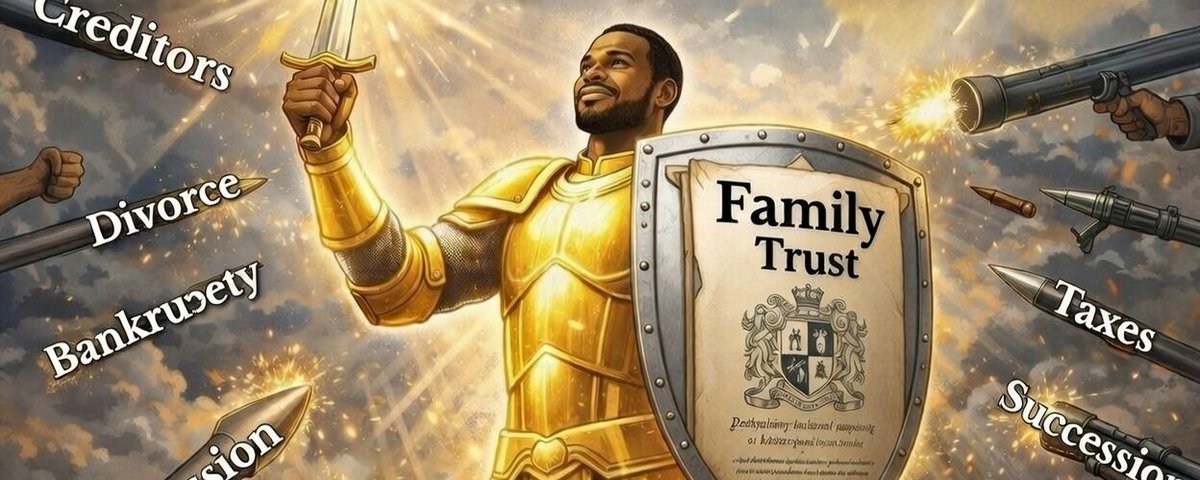
Because no weapon (legal, emotional or familial) should prosper against your legacy.
This article is general information, not legal or tax advice. Speak to an advocate about your specific circumstances.
Originally published on X: Unlocking the Power of Family Trusts in Kenya. By Benjamin Manani, Ben Manani & Co. Advocates.